
Application Essay Editing Services
In top-school admissions, essays are not supplementary — they are the deciding factor. Admissions officers care not about a list of experiences, but about how you think, what drives you, and your potential. At IvyPath, we start from the admissions-office perspective and narrative logic, analyzing school preferences and student strengths in depth, and helping students turn scattered experiences into a coherent, powerful storyline — so every essay speaks directly to what top schools look for.

Admissions Officer Perspective
We refine essay logic and language for each target program, restructuring the storyline and details according to how the committee actually reads.
Bilingual Mentor Collaboration
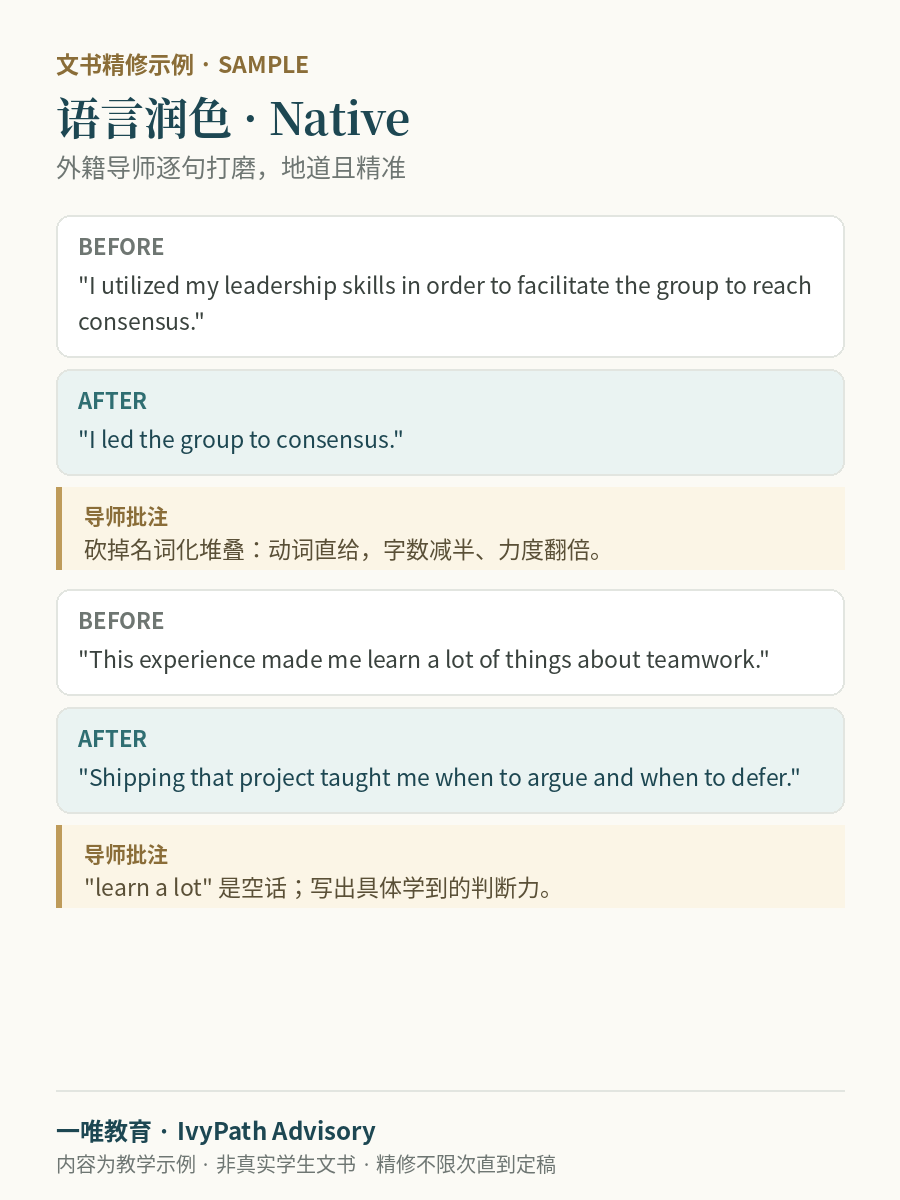
Chinese mentors uncover your background while native-speaking mentors polish the language — 30+ essay mentors matched by field.
Unlimited Revisions
No limit on revisions during the service period, with feedback documented every round until the final draft.
Essay Editing Process
Initial Consultation
We learn your application goals, academic background, and personal experiences, and build a tailored essay-writing plan.
Brainstorming
Multiple rounds of one-on-one interviews dig deep into your strengths and potential, gathering rich material for the essay.
Deep Research
Your mentor researches the programs you are applying to in depth, matching them against the traits revealed in the interviews to find the perfect fit.
Essay Drafting
A senior essay mentor writes the first draft around your strengths, keeping the content authentic and persuasive.
Multiple Revisions
Based on your feedback, the essay goes through multiple rounds of revision, polishing every detail.
Language Polishing
A native-speaking mentor with a background in literary writing refines the text so the language is precise and elegant.
Great Essays Are Excavated, Not Written
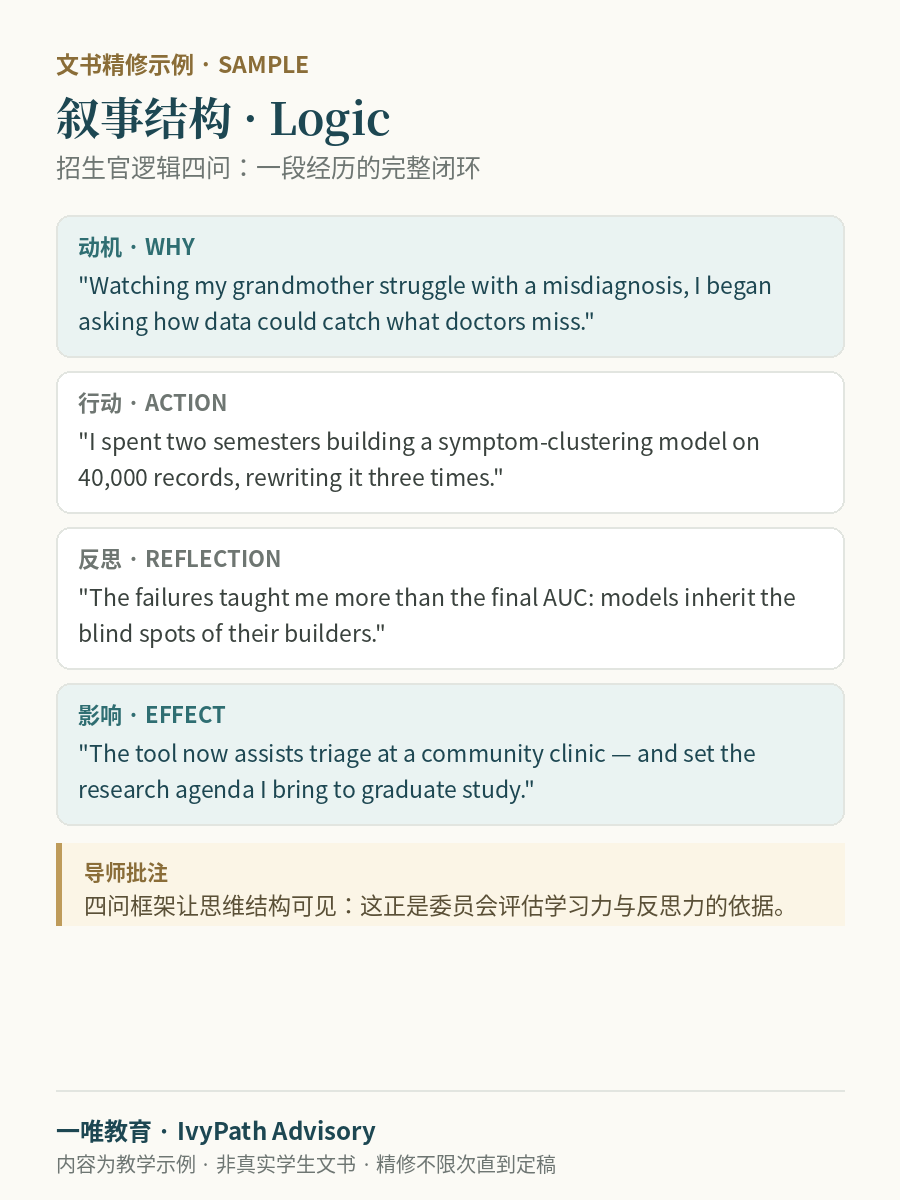
Admissions officers read hundreds of documents a day. What they screen for is not fancy wording but the structure of your thinking: why you did it, how you did it, what you came to understand, and what changed as a result. The IvyPath essay methodology is built around one standard — a good story = uniqueness + specificity + coherence.
Why You Did It
Motivation and resolve: what sparked this experience? What problem did you see, and what judgment did you make?
What You Did
Preparation and action: what exactly did you do, and with what methods — the more specific the details, the more credible the story.
What You Came to Understand
Reflection and synthesis: looking back from both theory and practice, which of your beliefs did this experience change?
What Changed
Results and impact: on the project, on others, on your next step — closing the loop gives the story weight.
The Four Questions of Admissions Logic · Tell every experience along this thread and your thinking shows itself
PS, SOP, or Resume: What Exactly Is the Difference?
Personal Statement
PS · Personal- The main arena of undergraduate applications: showing character, values, and growth
- Judged on clarity, honesty, empathy, and vividness
- Good material is detail with personality, not a list of achievements
Statement of Purpose
SOP · Purpose- The main arena of graduate applications: motivation, academic preparation, and career plans
- Judged on logical coherence, concise professionalism, and precise fit with the program
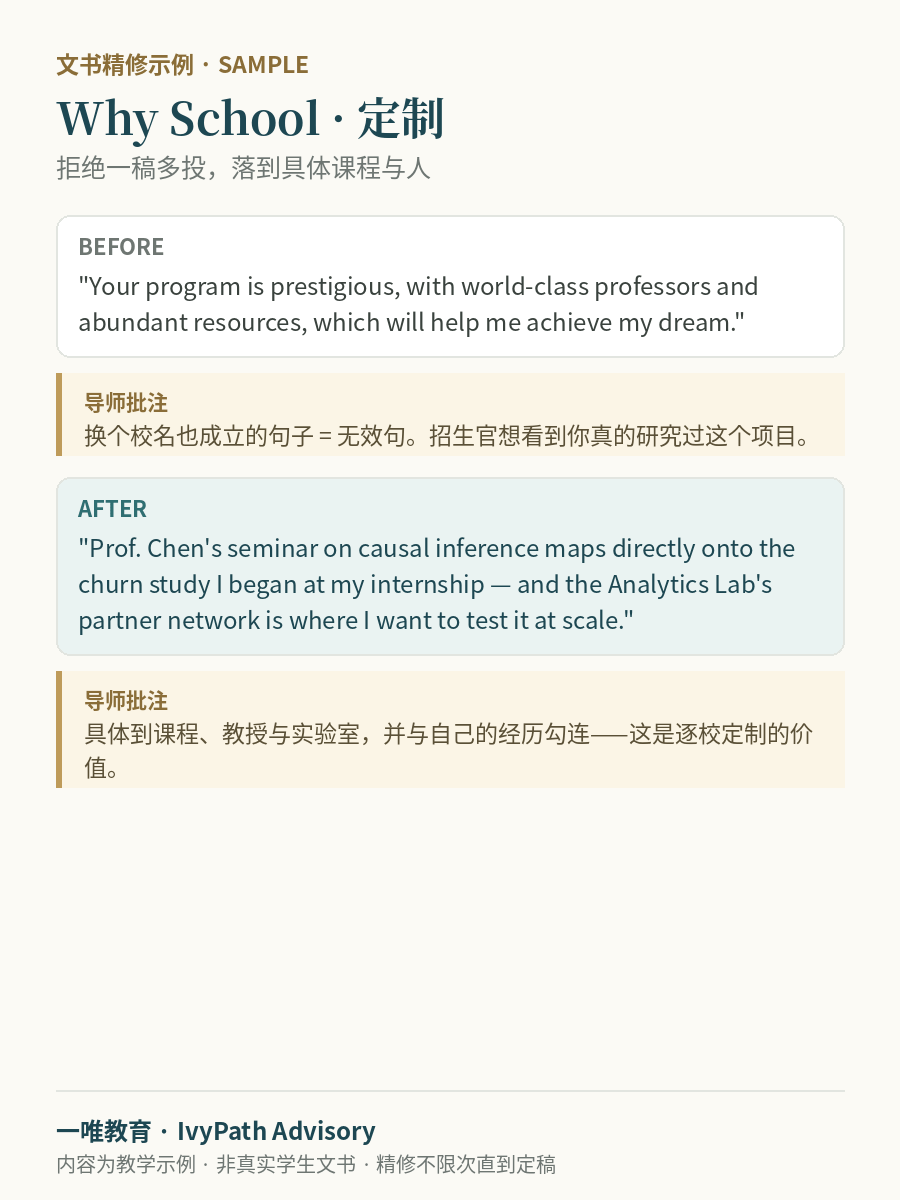
- Rewrite the Why School section for every school — never send one draft to all
Application Resume
Résumé / CV- Unlike a job resume: emphasizes academic foundation and relevance to the target program
- Tests your ability to organize and distill — one page that makes the main line clear
- Research, publications, and certificates are selected and ordered by target program
The Six Essential Modules of an SOP
The order can change, but no module should be missing; without an explicit word limit, keep it under 1,000 words
The Four Most Common Applicant Pitfalls
✗ Template Openings and Listed Experiences
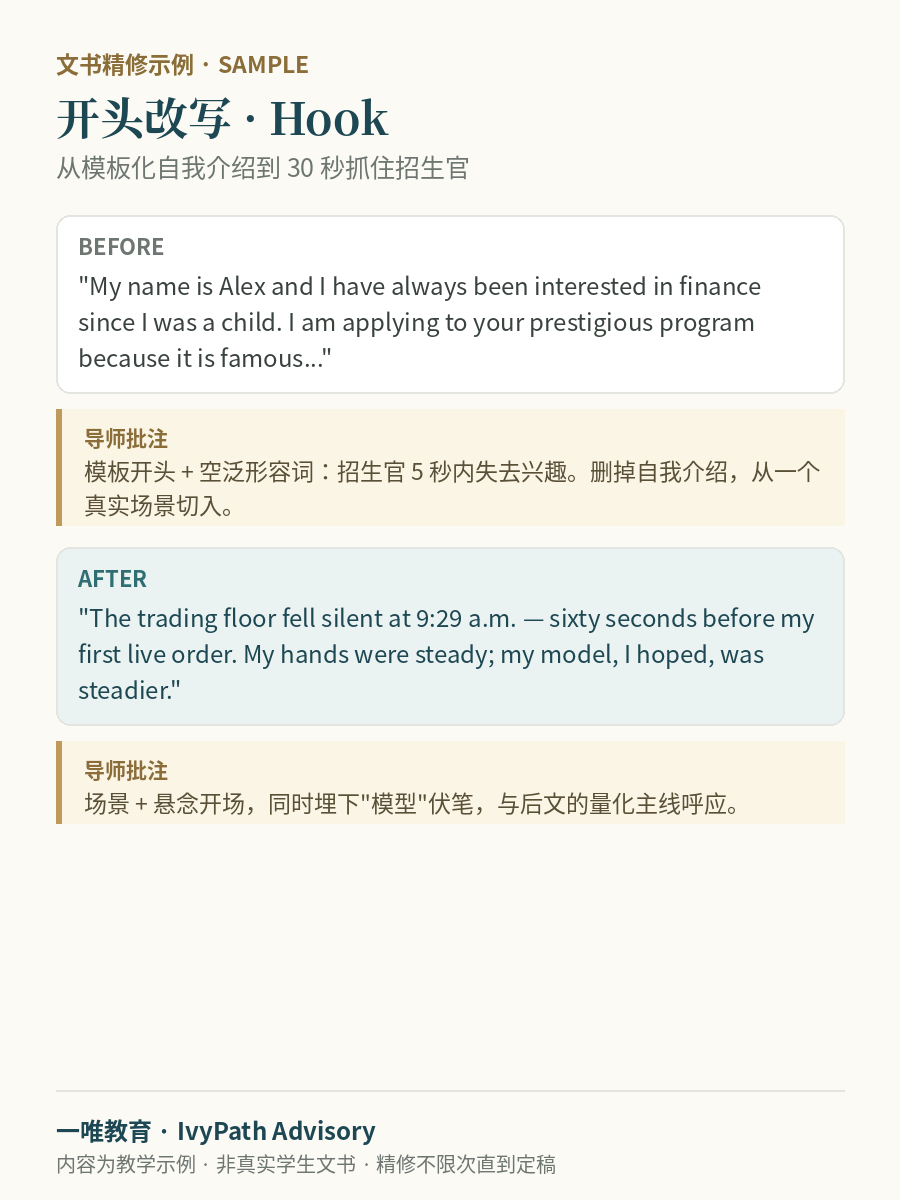
"My name is XXX and I am sincerely attracted by..." — an opening admissions officers spot instantly, followed by piled-up experiences with no logical link to the program.
✓ Open with a concrete scene or genuine motivation, and keep the whole essay on the one thread relevant to the program.
✗ Focusing on the Wrong Highlights
What you think shines (a long, generic list of awards) may look like commodity goods to an admissions officer; what is truly rare is often the unique experience you dismissed.
✓ Screen material from a former admissions officer’s perspective — pick stories backward from the program’s requirements rather than stuffing in whatever looks "biggest".
✗ All Skills, No Personality
An essay full of "developed leadership / communication skills" leaves no memory of who you are — schools admit people, not skill lists.
✓ Ground abilities in concrete details and personal signatures so a memorable person comes off the page.
✗ Relying on AI Generation
Since 2025 many schools have upgraded AI detection and follow-up questioning; a templated feel or inconsistent voice triggers review, and confirmed cases can be rejected outright.
✓ Use AI only to organize thinking; the final draft comes from real details unearthed in multiple rounds of live interviews — details AI cannot invent.
Why IvyPath Essays Are Different
Led by a Sitting Admissions Officer
Our essay committee was founded and is overseen by a sitting Stanford admissions officer, screening material and setting the main line by real admissions review logic.
Matched by Field
Essay mentors cover 70+ industry directions and are matched to students by major and direction — from background analysis to industry insight, the content reads like an insider wrote it.
First-Hand School Intelligence
We stay connected with admissions offices at the Ivies, Oxford, and Cambridge and attend their info sessions, adjusting essays to each school’s current-season preferences.
Unlimited Revisions
Full support from concept to final draft with unlimited revisions; native speakers polish line by line for a consistent style and idiomatic language.
Before and After: What Editing Changes
Teaching examples of four common edits (not real student essays)
Choose the Plan That Fits You
- ✓Narrative logic restructuring
- ✓Two rounds of bilingual mentor refinement
- ✓Idiomatic language polishing
- ✓Unlimited revisions until final draft
- ✓Everything in Single Essay Editing
- ✓Supplemental essays customized per school
- ✓Resume and recommendations coordinated
- ✓Unlimited revisions until final draft
Common Questions About Essay Editing
More questions?
Find the Right Service for Your Stage
Not Sure Where to Start?
A free 45-minute consultation with professional, actionable planning advice.